Donut Lab's Battery Retains 97.7% Charge After 10 Days in Third Test
Introduction to the Donut Battery
Finnish startup Donut Lab has made a significant breakthrough in battery technology with the release of its solid-state "Donut Battery." The latest independent test results show that the battery retains 97.7 percent of its charged capacity after being left idle for 10 days. This development marks a major milestone for the company, which claims to have created the world’s first production-ready solid-state battery for electric vehicles.
The test results were published by the VTT Technical Research Centre of Finland (VTT-CR-00125-26) on March 9, 2026. This report addresses previous speculation about whether the Donut Battery functions more like a supercapacitor than a traditional battery.
Understanding Supercapacitors
A supercapacitor, also known as an ultracapacitor, is a high-capacity energy storage device that sits between conventional capacitors and batteries. It stores charge electrostatically, allowing for rapid charging and discharging. However, this quick charge and discharge cycle often means that supercapacitors lose their charge quickly when not in use.
Ville Piippo, Donut Lab's Chief Technology Officer, addressed these concerns directly. He stated, “Since we unveiled the Donut Battery, there has been a lot of speculation and theories about whether it is a supercapacitor. In all its simplicity, this test proves that it is a battery.”
Latest Test Results
The Donut Battery is designed for Verge Motorcycles’ TS Pro and offers impressive specifications. It provides a 370-mile range, can be charged in just five minutes, and has an energy density of 400 Watt-hour per kilogram (Wh/kg). Additionally, it performs well under extreme temperatures, making it a promising option for electric vehicle manufacturers.
However, since its introduction earlier this year, there has been growing speculation about whether the Donut Battery is truly a solid-state battery or a high-performance supercapacitor due to its seemingly exceptional performance data.
To support its claims, Donut Lab previously released two independent tests. One demonstrated that the technology can charge from 0 to 80 percent in approximately 4.5 to five minutes. Another tested thermal stability and showed efficient operation at 176 and 212 degrees Fahrenheit (80 and 100 degrees Celsius), where the battery delivered 110 and 107 percent of its room-temperature capacity, respectively.
Now, in a third independent test, scientists evaluated the battery’s self-discharge performance. The results showed that the cell retained 97.7 percent of its charge after remaining idle for 10 days.
Self-Discharge Test Procedure
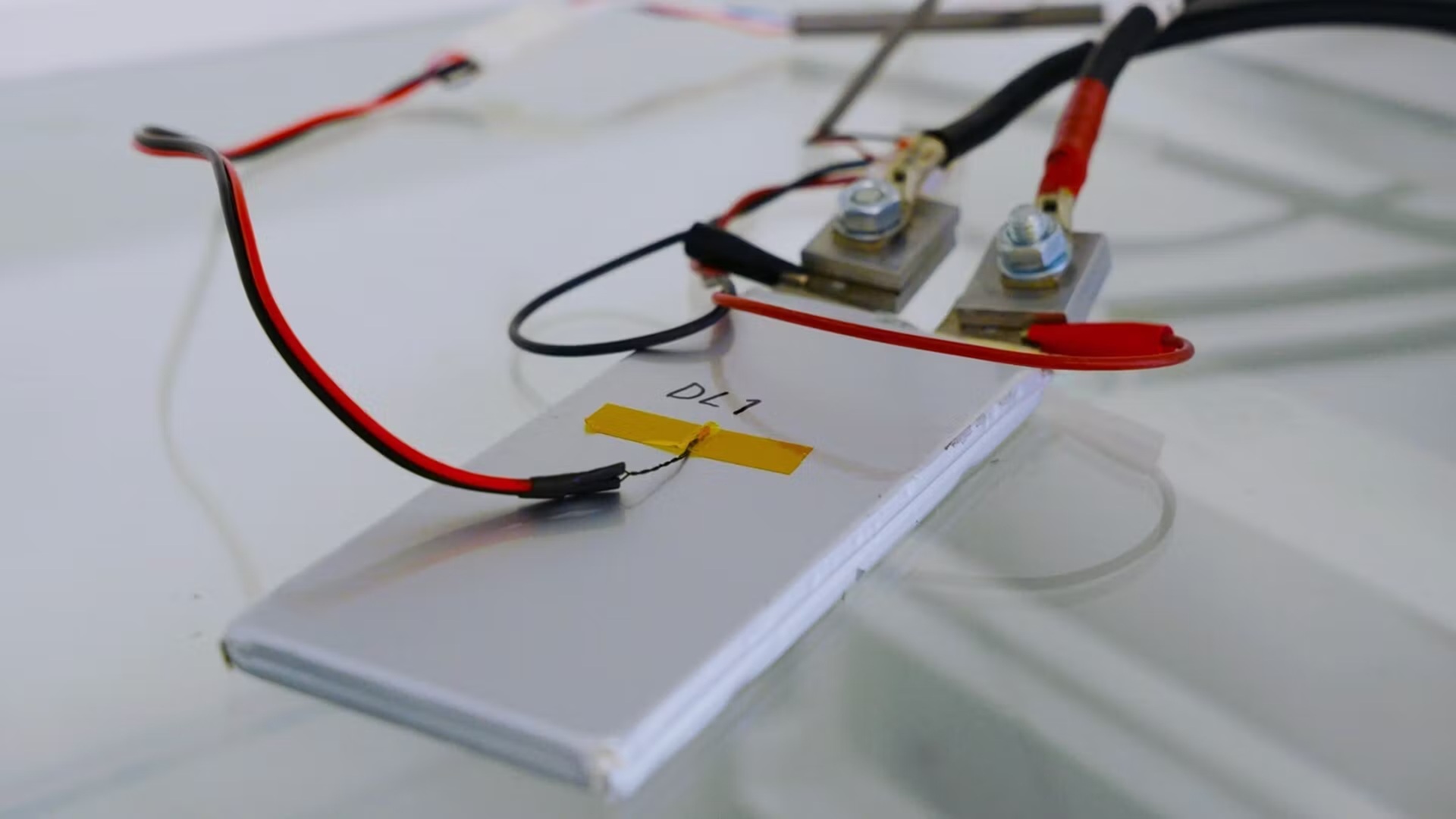
The experiment followed a straightforward procedure to measure how well the battery retains energy when not in use. VTT experts first conducted a 1C capacity test, which confirmed the cell delivered 26.5 amp-hours (Ah) of discharge capacity, slightly above the battery’s nominal 26 Ah specification.
For the self-discharge test, VTT first charged the cell to about 50 percent state of charge (13.335 Ah). The battery was left idle for 240 hours (10 days) at an ambient temperature of 72 to 82 degrees Fahrenheit (22 to 28 degrees Celsius). Its voltage was recorded every 10 seconds.
Following the idle period, VTT scientists discharged the cell and recovered 12.029 Ah. This was equal to 97.7 percent of the original charge. Voltage measurements revealed that most of the drop occurred immediately after charging.
Battery Durability Check
The battery’s voltage dropped by about 60 millivolts (mV) in the first 10 seconds after charging. It fell further to 103 mV within the first hour. The team attributed this to voltage relaxation after charging. Once stabilized, the battery’s voltage declined by only 12 mV from hour 10 to hour 240.
According to VTT’s report, the testing process caused no visible damage or structural changes to the cell. This further supported the battery’s stability under the test conditions.
Donut Lab said a capacity test carried out at the end of the test period confirmed that the voltage drop matched the amount of energy stored in watt-hours. “The Donut Battery behaved in the test exactly as a battery should,” the firm said.
Piippo added that a supercapacitor would have lost charge much faster over the same time period. “Supercapacitors charge and discharge quickly, but they also lose their charge quickly when not in use,” he concluded in a press release. “The Donut Battery behaves like a battery and can maintain a charge for significantly longer.”
Post a Comment for "Donut Lab's Battery Retains 97.7% Charge After 10 Days in Third Test"
Please Leave a wise comment, Thank you