Mesoscale Swimmers: Key to Drug Delivery Robots Inside the Body
Understanding the Mesoscale: A Unique Realm of Physics
In physics, the mesoscale is a fascinating domain that sits between the microscopic and macroscopic worlds. It's not just where tiny organisms like small larvae, shrimp, and jellyfish thrive, but also a place where traditional physics equations become more complex. While the macroscopic world is dominated by inertia and the microscopic by viscosity, the mesoscale presents a unique blend of both, requiring a new set of physical principles to explain it.
Breakthrough in Mesoscale Swimming Research
Physicists at Aalto University's Department of Applied Physics have made a significant discovery regarding how organisms swim in this intriguing mix of viscosity and inertia. Their findings were recently published in the journal Communications Physics. The study was led by Assistant Professor Matilda Backholm, who headed a multidisciplinary team exploring the mechanics of movement in the mesoscale.
The researchers found that efficient swimming in this realm isn't simply about moving faster or growing larger. Instead, it involves a phenomenon known as non-reciprocal motion, which breaks time reversal symmetry. This breakthrough helps bridge a gap in our understanding of fundamental physics and could lead to innovative applications, such as the development of mesorobots—tiny robots designed for medical tasks like drug delivery or minimally invasive procedures.
The Science Behind Efficient Swimming
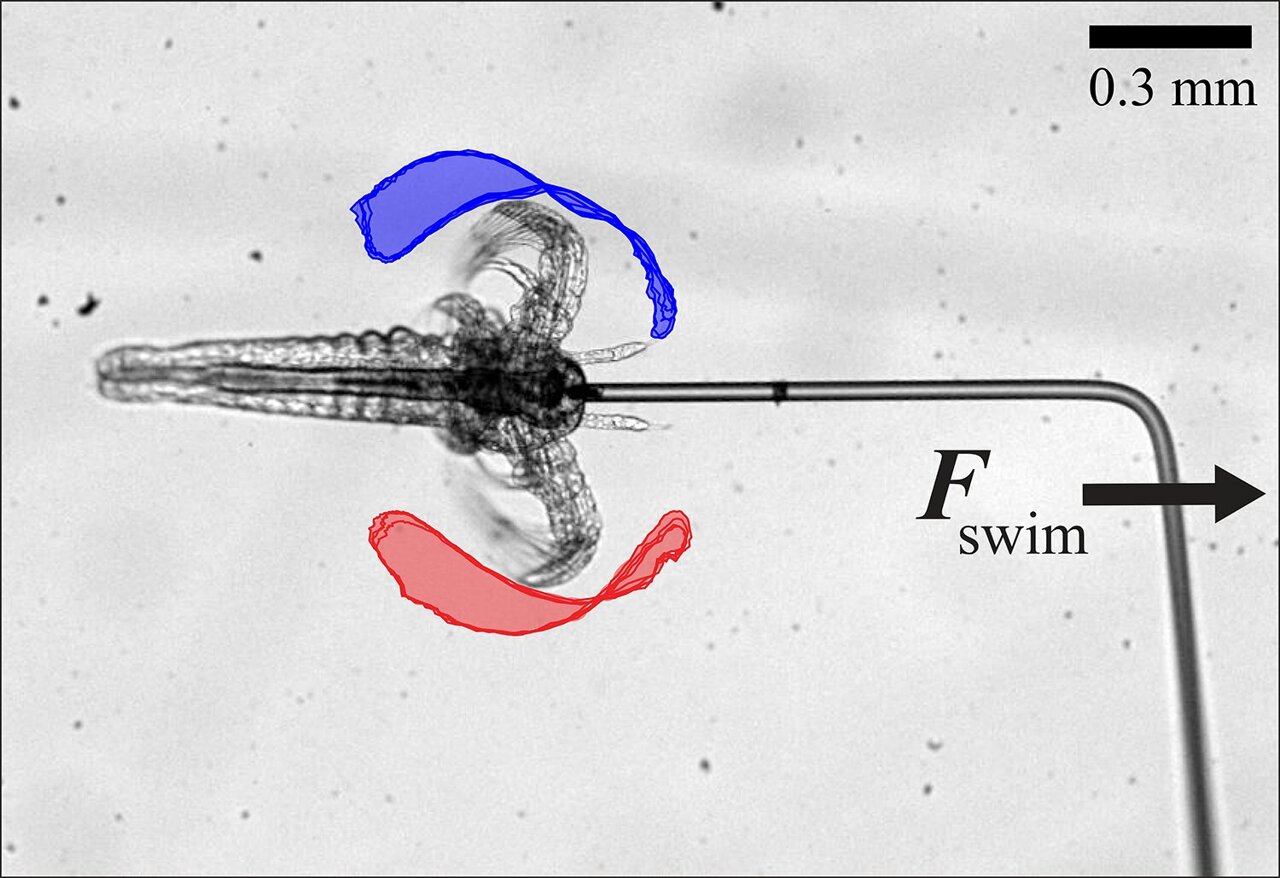
To investigate this, the team observed Artemia, which are meso-organisms measuring roughly 400–1,500 micrometers in length. They measured the physical forces involved when these organisms swam in water while connected to a cantilever.
"During swimming, Artemia flexed a joint-like part of its antenna, tracing a figure-eight shape," explained doctoral researcher Sharadhi Nagaraja. "We then decided to quantify and measure this motion range."
This figure-eight motion introduced an additional degree of freedom to Artemia's movement. It demonstrated that the organism was breaking time reversal symmetry—a concept that governs motion in the microscopic realm.
"Time reversal symmetry means that if you film a movie of swimming bacteria, the bacteria's motion must look different if you play the movie forward or in reverse. If this isn't the case, then the swimmer cannot move forward. That's a fundamental requirement at this highly viscous regime in fluid mechanics, but it's not a requirement anymore at the mesoscale," Backholm explains.
At the mesoscale, Artemia don't necessarily need to break time reversal symmetry to swim, yet they seem to do so with their antennas. "We found that if Artemia breaks time reversal symmetry more, they also swim better and have a higher propulsive force. This is something no one has been able to directly measure for a living organism before," Nagaraja adds.
Advanced Techniques for Measurement
Backholm's team filmed countless frames of Artemia's movement and used machine learning to analyze them. Handling the organisms required the combined expertise of physicists and biologists, along with a micropipette force sensor that Backholm has been instrumental in developing.
"The micropipette force sensor technique is ideal for directly measuring swimming forces of living meso-organisms, since it doesn't harm the swimmers and allows us to image the swimming motion simultaneously as we measure the time-resolved forces," postdoctoral researcher Rafael Ayala Lara explains.
From Organisms to Tiny Robots
Understanding the physics of swimming at the mesoscale could help engineers design and program what Backholm calls mesorobots for use in fields like medicine. "The idea is to have very small robots that deliver medication to some specific location in the body. For example, going directly into a tumor with the poison instead of poisoning the entire body. Such mesorobots would be able to deliver larger amounts of drugs than their microscopic counterparts," Backholm says.
This research highlights how science is catching up with nature, according to Backholm. "Nature has figured this out already: through evolution over millions of years, organisms have developed into the most efficient swimmers. Yet it's only now that engineers are starting to gain a deeper understanding."
Future Implications
The implications of this research extend beyond biology and into engineering. By studying how organisms navigate the mesoscale, scientists can develop more effective technologies for medical applications. This work represents a critical step toward creating advanced micro- and mesoscale devices that can operate within the human body with precision and efficiency.
Post a Comment for "Mesoscale Swimmers: Key to Drug Delivery Robots Inside the Body"
Please Leave a wise comment, Thank you